The discovery layer of ecommerce is undergoing a structural transformation. For the past decade, Shopify brands have built their organic traffic strategy around a reasonably predictable search engine optimisation model: target keywords, build topical authority, earn backlinks, rank. That model is not disappearing — but it is becoming insufficient.
AI-powered search surfaces have fundamentally changed the nature of the question a potential customer asks before they visit your store. In 2022, a customer might search “best sustainable leather bag.” In 2026, they ask “which sustainable leather bag brands are worth paying a premium for and what makes them different from each other.” The intent is similar. The discovery mechanism is entirely different. And the brands that will be discovered are the ones whose digital presence is structured to answer the second question, not just rank for the first.
How AI Search Actually Works for Product Discovery
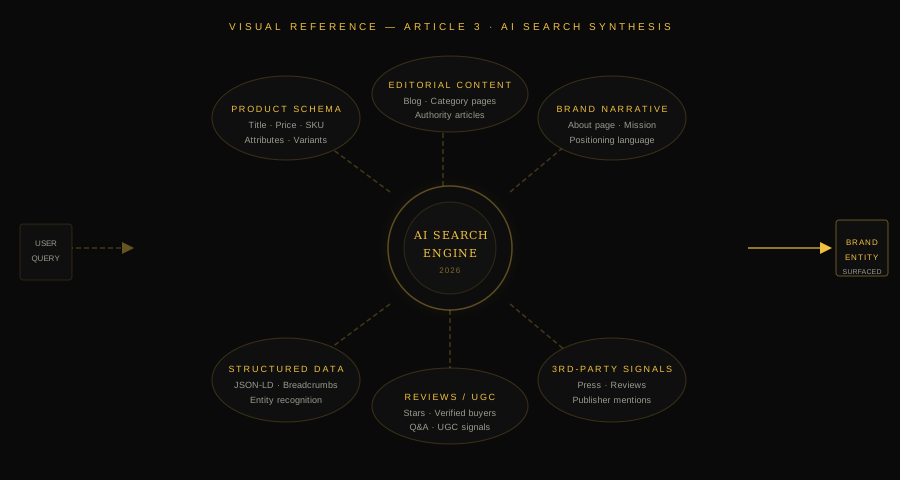
AI search engines — whether ChatGPT’s shopping integrations, Perplexity, Google’s AI Overviews, or the emerging native shopping surfaces on these platforms — do not simply rank pages. They synthesise information from multiple sources to construct an answer to the user’s question. When the question is about a brand or product category, the information those systems synthesise comes from several distinct source types: structured product data, editorial content, review signals, brand narrative pages, and the coherence of a brand’s information architecture across its digital presence.
What this means practically is that a Shopify brand’s “AI search surface” is not a single page or even a single website. It is the sum of its accessible, well-structured information across its own domain and across the sources that AI systems reference. A brand with excellent product listings but no editorial content about its category, no brand story that contextualises its positioning, and no presence in the kinds of editorial sources AI systems trust — that brand effectively does not exist in AI search.
Entity Recognition and Brand Architecture
The underlying mechanism of AI search visibility is entity recognition: the ability of AI systems to “know” that your brand exists as a discrete, well-defined entity with specific characteristics, a clear position, and reliable associations. Entity recognition is built through consistent, structured, repeated information signals across your digital presence.
For Shopify brands, this means that the architectural decisions that affect AI search visibility go far beyond keyword optimisation. Schema markup that clearly communicates product attributes, brand identity, and product relationships. About and brand story pages that use consistent, specific language about what the brand does and for whom. Category and collection pages that communicate the brand’s perspective on its product area, not just its product inventory. Blog content that positions the brand as an authoritative voice in its category — not keyword-targeted content, but genuinely informative editorial that provides the kind of information AI systems are trained to surface.
2026 search reality: Traditional SEO asked “how do I rank for this keyword?” AI search optimisation asks “how do I become the brand that AI systems associate with this category and these attributes?” The former is a page-level question. The latter is a brand architecture question.
Product Data Quality and AI Shopping Surfaces
On the more operational side, AI shopping surfaces — including Google’s AI-powered shopping integrations and ChatGPT’s product recommendation features — are directly dependent on the quality and completeness of structured product data. This is an area where many Shopify stores are significantly under-prepared.
The minimum viable product data for AI shopping surfaces in 2026 goes well beyond title, description, and price. It includes rich attribute data (materials, dimensions, manufacturing origin, care specifications), complete and accurate product variants that map correctly to search intent, high-quality images with descriptive alt text that serves as a text signal for AI processing, and product descriptions that are written as genuine editorial content rather than specification lists.
UAE-based ecommerce brands targeting regional and international luxury customers have found that AI shopping surfaces are particularly important for the high-consideration product categories that dominate premium retail. When a potential customer in Dubai asks an AI assistant to recommend premium skincare options available with local shipping, the brands that appear in that answer are determined almost entirely by data quality and brand entity strength — not by traditional SEO metrics.
The Content Architecture Imperative
The single most actionable shift for Shopify brands seeking AI search visibility is investing in what might be called authority content architecture: a structured programme of editorial content that builds the brand’s presence as a genuine information authority in its category.
This is not a blog strategy in the traditional sense. It is a deliberate construction of the information landscape around the brand — answering the questions that customers in a given category genuinely ask, from a brand perspective that is unique and credible. The quality threshold is high. AI systems are increasingly capable of distinguishing between content that exists to rank and content that exists to inform. The latter is what gets surfaced.
For premium and luxury Shopify brands, the content strategy has an additional dimension: the brand voice and editorial quality of the content must match the premium positioning of the products. Content that reads as generic SEO output — regardless of how technically well-optimised it is — undermines brand positioning. Content that reads as genuine expertise from a brand that understands its category deeply reinforces it.
Practical AI Search Readiness for Shopify Brands
At a structural level, AI search readiness for a Shopify brand in 2026 involves attention to several specific areas: complete and accurate structured data implementation across all products and collections; a brand identity page that uses consistent, specific language about what the brand is, who it serves, and what distinguishes it; collection and category pages that provide genuine editorial context for the products within them; a programme of category-authority content that addresses genuine customer questions; presence in the third-party editorial sources that AI systems weight heavily for category expertise signals; and performance infrastructure that ensures pages load fast enough to be indexed reliably.
Is your Shopify store AI-search ready?
We work with premium Shopify brands on content architecture and technical infrastructure that builds AI search visibility as a long-term competitive asset.
The Strategic Opportunity for Premium Brands
There is a window of significant competitive advantage available to Shopify brands that move quickly on AI search architecture. Most brands are still operating in a traditional SEO framework. The brands that build genuine AI search visibility now — through entity strength, content authority, and product data quality — will establish a discovery advantage that becomes increasingly difficult to displace as AI search continues to capture a greater share of product discovery.
For premium brands in particular, the fit is natural. The kind of content that builds AI search authority — specific, expert, editorial, brand-voice-consistent — is also the kind of content that builds premium perception with human readers. The investment is not a divergence from brand strategy; it is an expression of it.