The brief usually reads the same way: premium products, a polished Shopify theme, beautiful photography, and a vision to position the brand as the luxury choice in its category. Six months after launch, the founder is frustrated. The store performs fine. But it doesn’t feel luxury.
This is the central tension in high-end ecommerce: the gap between how expensive a brand is and how expensive it feels. For most Shopify stores chasing premium positioning, that gap is enormous — and it has almost nothing to do with budget.
The Template Problem Is Not Visual — It’s Structural
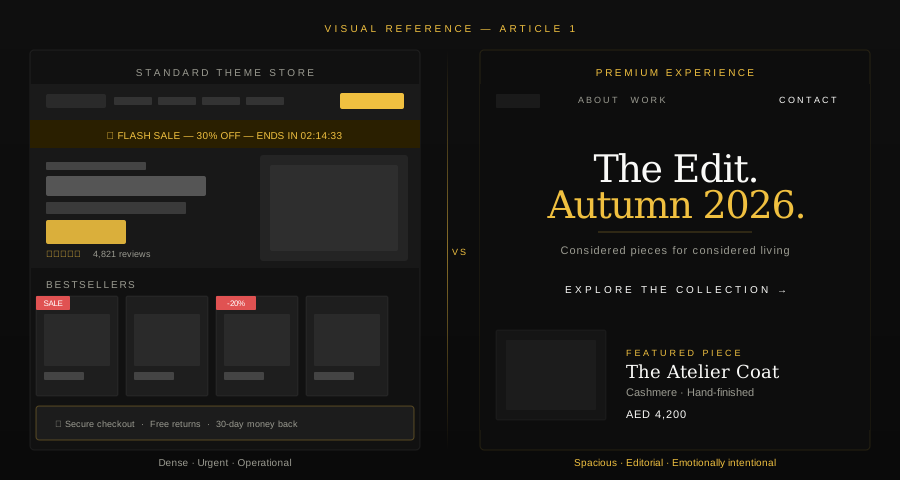
The most common misconception is that a luxury Shopify store requires a custom theme. It doesn’t. What it requires is structural intentionality — a series of deliberate decisions about information hierarchy, pacing, negative space, and interaction that premium retail gets right and template builds fundamentally cannot.
Premium themes for Shopify are engineered for versatility. They are designed to work for 10,000 different merchants across 400 different product categories. That means they contain compromises. The section spacing is a median compromise. The typography scale is a practical compromise. The mobile layout is a safe, reliable compromise. None of these compromises are mistakes — they are features of a product built for scale. But they are invisible ceilings on luxury perception.
When a customer arrives at a Harrods, a SSENSE, or a premium contemporary brand’s digital storefront, what they encounter is not a generalist design system. It is a crafted editorial space in which every pixel, every pause, every product reveal has been calibrated to produce a specific emotional response. That level of intentionality cannot exist inside a theme that was built to be everything to everyone.
What Actually Creates Premium Perception
Premium perception in ecommerce is not created by expensive visual assets. It is created by the relationship between elements — the density of information, the pacing of content, the restraint of decoration, and the confidence of the typography.
Consider negative space. In mass-market retail design, negative space signals unused opportunity — room that could be showing products, urgency messages, promotional banners. In luxury retail design, negative space is a message. It communicates that this brand is selective about what it shows you. It communicates confidence. It communicates that the product does not need to compete for attention. The product simply exists, and the space around it amplifies its presence.
“The absence of information is itself information. Luxury brands understand that restraint is a signal of confidence. A page that shows everything is a page that trusts nothing.”
Template builds almost universally fail at this. The section system that makes Shopify themes flexible is the same system that encourages filling every section with content. The UX logic of “if there’s space, fill it” is precisely backwards for luxury positioning.
Typography Is Doing More Work Than You Think
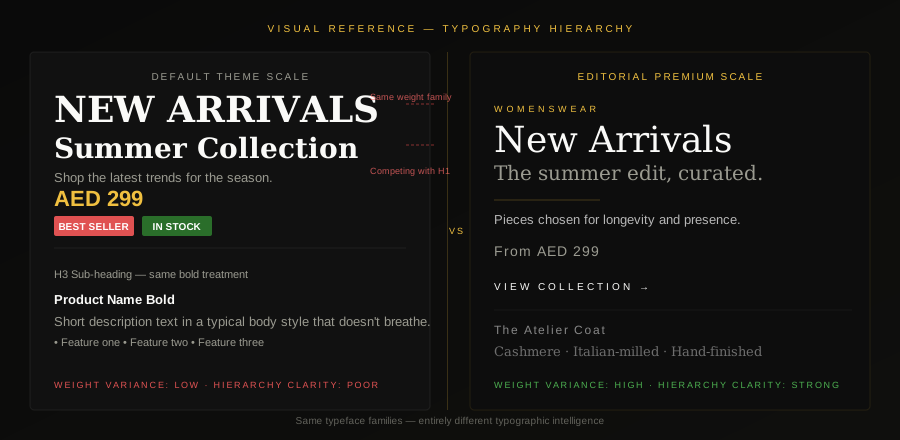
The typographic system of a premium brand is not simply a font choice. It is a complete communication architecture — a hierarchy of scale, weight, spacing, and contrast that tells the customer where to look, how to feel about what they’re seeing, and how to interpret the brand’s relationship with them.
Most Shopify themes offer a heading font, a body font, and a fixed set of heading sizes. This is not a typographic system. It is a typographic starting point that gets compromised by app injection, section defaults, and the pressure of populating the template quickly. The result is a store where the typography is technically correct but psychologically incoherent — headings that are too large on mobile, body text that is too small on desktop, line-heights that create visual tension instead of comfort.
Luxury retail typography tends toward three characteristics that templates rarely achieve: restraint in weight variation (premium brands rarely use bold text freely — weight is reserved for what genuinely deserves hierarchy), generous line-height in body text (editorial reading rhythm vs. utility reading rhythm), and intentional scale relationships between heading levels that feel mathematically proportional rather than visually arbitrary.
The Product Page Is the Luxury Test
If the homepage is the brand’s editorial statement, the product page is where luxury positioning either holds or collapses. In most Shopify stores — regardless of how premium the brand’s positioning — the product page structure is essentially identical: images left, details right, add-to-cart, reviews below, recently-viewed. This structure emerged from conversion optimisation studies conducted on mass-market retailers. It works for transactional buying. It works poorly for considered, high-AOV purchases.
Luxury product pages do not just present information — they build the case for ownership. They give the customer permission to invest emotionally in the product before asking them to invest financially. This requires a fundamentally different information architecture: the story before the specification, the craft before the price, the aspiration before the action.
Brands operating in the UAE luxury market, the UK contemporary premium sector, and the US high-end DTC space have demonstrated consistently that elongated product pages with editorial narrative sections outperform standard layouts for products above a certain AOV threshold. Not because longer is better, but because considered purchase decisions require narrative scaffolding that pure specification layouts cannot provide.
Strategic insight: For high-AOV products, conversion is not primarily a function of how easy the purchase is to complete. It is a function of how well the store builds the emotional case for ownership before the customer reaches the add-to-cart button. Template layouts are optimised for the former. Premium layouts must address the latter.
Motion and Interaction Design as Perception Signals
How a store moves is as significant as how it looks. Premium digital experiences treat motion as a communication medium: animations that feel deliberate communicate intentionality; animations that feel rushed or mechanical communicate generic execution.
The most common motion design failure in Shopify stores is overuse of generic easing functions at standard timing. The hover transitions that ship with commercial themes are functional but unmemorable. They serve the interaction without serving the brand. Premium experiences use motion sparingly and with precision — a product image that fades rather than pops, a navigation that slides with measured deceleration, an add-to-cart interaction that feels like a considered commitment rather than a button click.
Singapore and Hong Kong premium retail customers — who spend significant time navigating high-end brand digital experiences — demonstrate particular sensitivity to motion quality. In markets where mobile commerce is the primary channel, the quality of touch interaction animations becomes a direct proxy for brand quality perception.
The Invisible Architecture
Beyond the visual layer, premium Shopify experiences are built on decisions that customers never consciously notice but always feel: load performance that doesn’t disrupt the visual experience, font rendering that is crisp across device types, colour management that ensures product photography looks as designed across varied screens, and cart interactions that don’t interrupt the browsing flow with jarring overlays.
These are not glamorous decisions. They are operational and technical decisions. But they are the decisions that separate brands that look premium from brands that feel premium. The difference between those two states is precisely what determines whether a high-ticket customer completes their purchase or leaves to find the brand elsewhere.
Is your Shopify store doing justice to your brand positioning?
We work with premium and scaling brands on commerce architecture that closes the perception gap between product quality and digital experience quality.
What This Means for Shopify Strategy in 2026
The mainstream conclusion is that luxury brands need to leave Shopify for custom platforms. This is the wrong conclusion. What premium brands need is to stop treating Shopify as a template deployment system and start treating it as a commerce architecture platform — one that, when built with intent, can produce experiences that genuinely compete with bespoke builds at a fraction of the cost and complexity.
The gap between luxury Shopify and template Shopify is not primarily a technology gap. It is a design thinking gap, a strategic clarity gap, and a craft execution gap. Closing it requires working with people who understand that luxury perception is not a visual style — it is a psychological system built through hundreds of intentional, specific decisions.
For brands navigating the transition from good to genuinely premium digital presence, the most important question is not “how much does this cost?” but “who understands the problem at the depth it needs to be solved?”