The pattern is consistent enough to be predictable. A brand invests significantly in a Shopify redesign. The new store launches, there is a brief improvement in engagement metrics, and then twelve months later the brand is discussing the next redesign because the fundamental problems remain.
The post-mortem conversation almost always reaches the same conclusion: the redesign was beautiful. It was executed well. It just didn’t solve the actual problem. And this is the central failure mode of the majority of ecommerce redesigns: they are built to solve the wrong problem.
The Diagnosis Problem
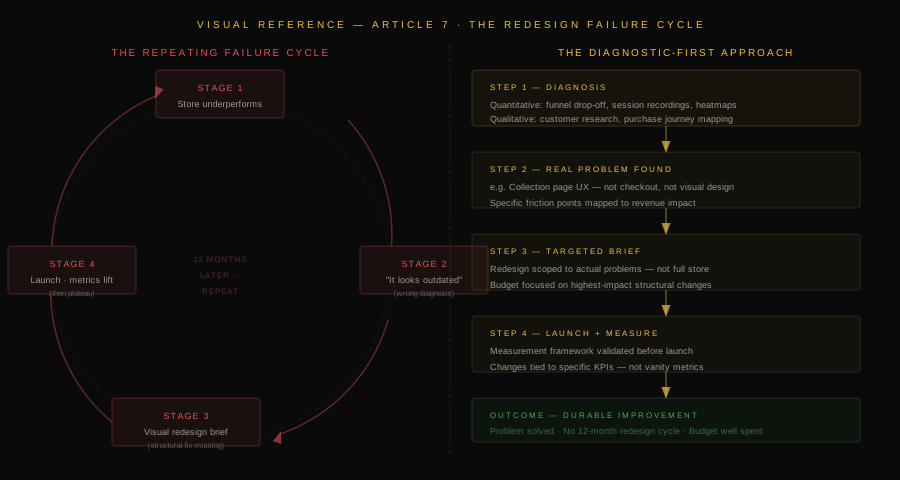
Most Shopify redesign briefs are written as aesthetic briefs. The brand has identified that the current store looks dated, feels off-brand, or performs below industry benchmarks. The brief asks for a better-looking store with improved UX. This is a reasonable response to a symptom — but symptoms and underlying causes are rarely the same thing in ecommerce.
A store that looks dated may be underperforming because of its visual design. Far more often, it underperforms because of structural issues that the redesign brief doesn’t capture: a product information architecture that doesn’t support the customer’s consideration process, a collection and navigation structure that doesn’t map to how customers actually think about the product range, a homepage that leads with the brand’s priorities rather than the customer’s, or a checkout flow that has accumulated friction from successive app additions over several years.
A redesign that addresses the visual problem while leaving the structural problem intact will always underdeliver. The store will look better. The underlying conversion constraint will remain.
“The most expensive redesigns are the ones that solve the wrong problem with genuine expertise. You get a beautiful store that still doesn’t convert at its potential — and now you’ve spent your redesign budget on the wrong solution.”
What Good Diagnosis Actually Looks Like
A redesign process that has a real chance of producing durable improvement begins not with design exploration but with diagnostic work: what specific user behaviour patterns are creating conversion friction, where in the customer journey is the experience losing people it should be retaining, what aspects of the current architecture are fundamentally misaligned with the brand’s actual customer and their actual purchase journey.
This diagnostic process involves looking at quantitative data — session recordings, funnel analytics, conversion path analysis — alongside qualitative data: actual customer research about how they think about the product, what questions they need answered before purchasing, and what aspects of the current experience create doubt or uncertainty. The combination of these two data types usually reveals a set of structural problems that are very different from what the brief describes.
Common diagnostic finding: Brands frequently believe their conversion problem is at the checkout stage when the actual drop-off is happening on collection pages or early in product page reading. The redesign brief focuses on checkout optimisation. The structural fix required is actually in collection page merchandising and product information architecture. Without diagnosis, the right problem is never identified.
The Migration Execution Problem
Even redesigns built on correct diagnosis frequently fail because of execution problems specific to the migration phase. The most common is content debt: a new design is launched without adequately updating the product descriptions, collection copy, and supporting content that the new architecture assumes will be there. The new template structure calls for richer, more editorial product descriptions; the actual content is the same sparse bullet lists that existed in the previous store. The design can only do so much with inadequate content.
A second common execution failure is app conflict management. Shopify stores that have operated for several years typically have a significant number of installed apps, some of which have injected code or CSS modifications that interact poorly with a new theme. A redesign that doesn’t explicitly audit and resolve these conflicts will have a launch that is technically correct but functionally broken in specific scenarios — and the debugging costs and timeline delays this creates are disproportionate to the complexity of the underlying issues.
Post-Launch Drift
The twelve-month failure pattern is partly explained by what happens after launch. A newly redesigned Shopify store is a coherent system. Over the following months, it is subjected to: new app installations for marketing experiments, promotion banner additions, product range expansions that push the template into configurations it wasn’t designed for, A/B tests that alter elements that were deliberately designed, and team members who are not design-trained making visual modifications to address immediate business needs.
This is post-launch drift, and it is the mechanism through which most good designs degrade into mediocre ones. Within twelve months of a careful redesign, many stores have drifted significantly from the designed state — not through any single dramatic change but through the accumulation of many small compromises, each individually justified and collectively destructive.
Preventing post-launch drift requires two things: a style guide and component library that makes it easy to add new content within the design system rather than outside it, and organisational clarity about which decisions require design review before implementation. Neither of these is technically complex. Both are consistently neglected.
Redesign vs. Iteration: When Each Is Right
The most successful ecommerce brands rarely do full redesigns on a regular cadence. They maintain a baseline design system and iterate continuously within it, reserving full redesigns for situations where the brand’s positioning has fundamentally changed or where the underlying platform or architecture is genuinely inadequate for the current requirements.
For most brands considering a redesign, the more effective and cost-efficient path is structured iteration: a diagnostic process that identifies the specific high-impact problems, a design and development engagement focused on those specific problems, and a measurement framework that validates whether the changes produced the intended result. This approach produces more durable improvement at lower cost and lower risk than comprehensive redesigns.
Considering a redesign or dealing with one that underdelivered?
We start with diagnosis before we start with design — because the problem you’ve identified is rarely the problem you need to solve.