The Shopify vs. custom commerce debate has been running for over a decade. It generates strong opinions, confident recommendations, and a consistent failure to actually help brands make the right decision for their specific situation. The reason is simple: the question is almost always being asked backwards.
Most brands approach this decision by asking “which platform is better?” This is the wrong question. Platforms are tools. The right question is “what does my business actually need, and which approach is best positioned to deliver that?” Answering this question correctly requires an honest examination of business requirements, operational realities, and the often-underestimated costs of both paths.
What Shopify Actually Is in 2026
The Shopify of 2026 is not the Shopify that informed most of the arguments against it. It has evolved significantly from a hosted ecommerce platform with a fixed feature set to a sophisticated commerce infrastructure that supports everything from simple D2C operations to complex multi-region, multi-currency, B2B-enabled enterprise deployments through Shopify Plus and the headless capabilities of the Storefront API.
What Shopify provides that custom builds typically cannot match: a production-grade checkout that converts reliably across devices and payment methods, a payments infrastructure that handles the complexity of global commerce, a security and compliance architecture maintained by a company whose core business is keeping it current, and an ecosystem of integrations that represents years of development investment from hundreds of specialised vendors.
What Shopify’s architecture constrains: the ability to build fundamentally novel purchase flows that don’t map to the platform’s core commerce model, deep customisation of the transactional layer without Checkout Extensibility (and even with it, there are limits), and the ability to optimise performance beyond what the platform’s hosting architecture allows for the most demanding applications.
What Custom Commerce Actually Means in 2026
Custom commerce in 2026 almost universally means headless commerce: a custom frontend application — typically built in a React framework — that communicates with a commerce backend through APIs. The backend may be Shopify itself (using the Storefront API), a purpose-built headless commerce platform like Commercetools or Crystallize, or a custom-built system.
The appeal of custom headless is genuine: unlimited frontend flexibility, the ability to build truly novel interaction patterns, complete control over performance, and the freedom to integrate any external system without platform constraints. These are real advantages for a specific class of commerce requirement.
The cost of custom headless is also genuine and is systematically underestimated: initial development cost that is typically 3-5x a comparable Shopify Plus build, ongoing development cost for maintaining a custom frontend as browser environments, security requirements, and commerce features evolve, the inability to benefit from platform-level investments that Shopify makes continuously in checkout, payments, and commerce infrastructure, and the significant expertise requirements for teams maintaining a custom commerce system.
“The decision to go custom is rarely wrong in principle. It is almost always wrong in practice because the operational cost of maintaining a custom commerce system is invisible at the time the decision is made and very visible twelve months later.”
The Decision Framework
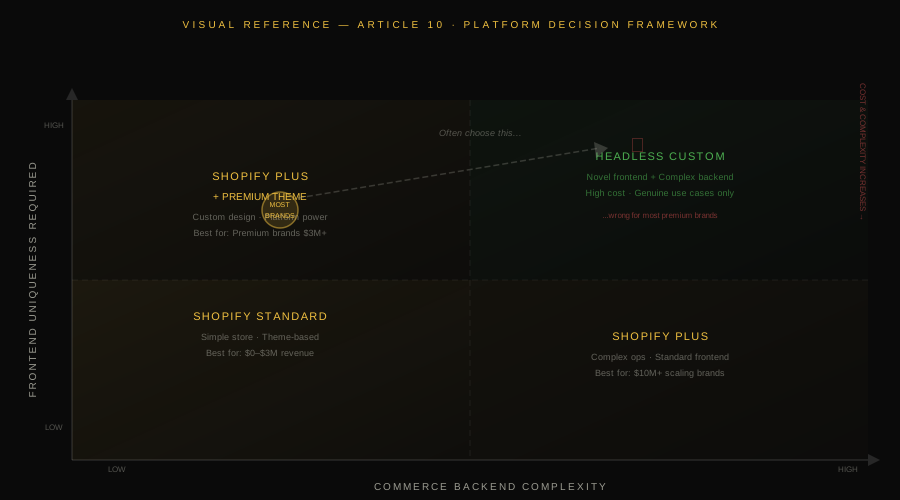
Rather than a platform comparison, the useful framework for this decision is a requirements assessment across two dimensions: frontend uniqueness requirements and commerce backend complexity requirements.
Brands with standard commerce flows — product catalogue, cart, checkout, account — but requiring distinctive, premium frontend experiences should be on Shopify Plus with a carefully built custom theme, not on a headless architecture. The investment in frontend distinctiveness is achievable within Shopify’s architecture at significantly lower cost and risk than headless, and the commerce infrastructure benefits are retained.
Brands with genuinely novel commerce models — subscription configurations that the Shopify model doesn’t support natively, complex B2B pricing architectures, multi-entity inventory models that require custom logic — have a genuine case for considering headless backends. Even in these cases, the correct analysis is whether Shopify Plus’s extensibility features can address the specific requirement before concluding that custom is necessary.
2026 reality check: The number of brands that genuinely require custom commerce infrastructure is significantly smaller than the number that choose it. Most custom builds are solving a problem that Shopify Plus — correctly architected — could also solve, at lower cost, lower risk, and with the benefit of continuous platform investment rather than the burden of continuous custom maintenance.
The Premium Brand Question Specifically
For premium and luxury brands — which represent a significant portion of the brands asking this question — the decision is almost universally in favour of a well-built Shopify Plus implementation over custom. The primary argument for custom from these brands is almost always aesthetic: the desire for a digital experience that is genuinely distinctive and does not look like a Shopify store.
This is a legitimate aspiration. It is also achievable within Shopify Plus. The distinctive luxury digital experiences that premium brands point to as reference — the stores that feel genuinely editorial, genuinely crafted, genuinely premium — are built on the conviction that great design and development executed with intent can produce remarkable results within the platform constraints. They are not built on escaping those constraints.
The brands that pursue custom builds primarily for aesthetic differentiation almost universally achieve less distinctive results at significantly higher cost than they would have with a focused, premium Shopify Plus engagement. The reason is that design distinctiveness is a function of design thinking, craft skill, and strategic clarity — not of platform choice.
When Custom Is Actually Right
Custom is genuinely right in a specific set of circumstances: when the commerce model is fundamentally incompatible with Shopify’s architecture, when performance requirements exceed what Shopify’s hosting infrastructure can deliver for the specific application, when existing enterprise infrastructure requires integrations that Shopify’s API architecture cannot support, or when the organisation has the technical team, operational capacity, and financial resources to maintain a custom system over the long term.
Most brands evaluating this decision should be honest with themselves about whether they meet these criteria before choosing custom. For those that do not, a well-built Shopify Plus implementation — architected by people who understand both the platform’s capabilities and its constraints — will produce better outcomes at lower total cost than a custom build begun for the wrong reasons.
Trying to decide between Shopify Plus and custom?
We’ve helped brands make this decision correctly and build both types of solution. The right answer depends entirely on your specific requirements — let’s work through them together.