There is a persistent belief in ecommerce that the difference between a premium digital experience and a mass-market one is primarily a function of budget — better photography, a more expensive theme, perhaps a dedicated designer. This belief is responsible for more failed premium brand launches than any other single misconception in the industry.
The actual gap is structural. It lives in decisions that are invisible to the casual observer but immediately felt by the customer. Understanding it requires stepping back from the visual layer entirely and examining what premium and mass-market retail are actually trying to accomplish — because they are not the same thing.
Different Psychological Goals, Different Design Systems
Mass-market ecommerce is fundamentally transactional. Its primary goal is to reduce the friction between a buying intention and a completed purchase. Every UX decision in a high-volume mass-market operation flows from this: minimise clicks, surface promotions quickly, create urgency, simplify the path from discovery to checkout. These are the principles that built the conversion optimisation industry. They work extraordinarily well — for transactional retail.
Premium ecommerce has a different psychological goal. It is not trying to complete a transaction; it is trying to build an emotional relationship. The customer’s relationship with a premium brand is established long before they reach the cart — or it is not established at all, and they will not complete the purchase regardless of how optimised the checkout flow is.
This is the strategic gap that most brands miss when they attempt to position themselves as premium while building their Shopify store like a transactional retailer. The structure itself contradicts the positioning.
The Urgency Problem
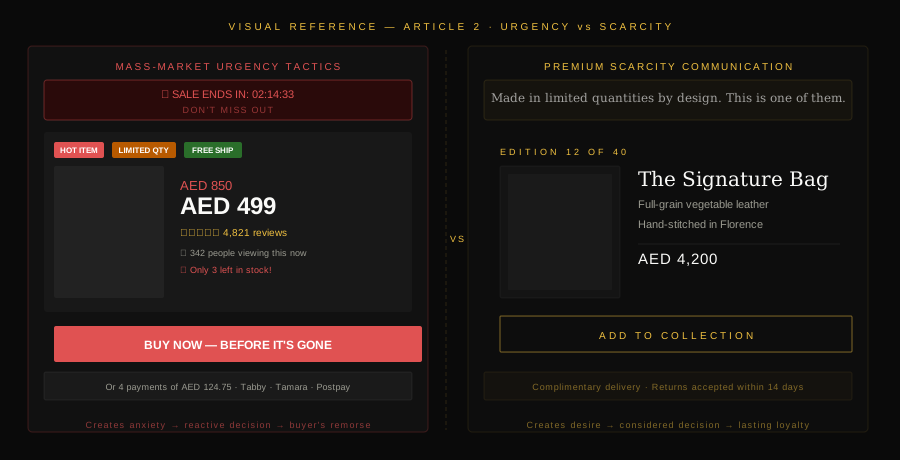
Perhaps the single most visible marker of this gap is the use of urgency mechanics. Countdown timers, “X left in stock” notifications, flash sale banners, exit-intent popups — these tools exist entirely within the transactional retail framework. They work by creating anxiety. They create the psychological conditions under which a customer makes a fast, emotionally reactive decision rather than a considered, emotionally resonant one.
Luxury retail has understood for centuries that urgency destroys premium perception. The relationship between scarcity and desire in luxury is entirely different from the relationship between urgency and conversion in mass-market. Scarcity, when communicated correctly, reinforces desirability. Urgency, when used as a conversion tactic, communicates desperation — and customers feel it immediately, even when they cannot articulate why.
“The countdown timer is not just a UX element. It is a statement about how the brand views its relationship with the customer. Premium brands do not rush their customers. They trust them.”
Information Density and the Trust Architecture
Mass-market and premium retail also diverge significantly in how they approach information. Mass-market digital retail tends toward high information density — more products per page, more specifications per product, more reviews per visible section. The logic is that more information reduces barriers to purchase decisions.
Premium retail operates from a different trust model. The information it chooses to surface is highly curated, not comprehensive. A luxury brand does not show you everything — it shows you what it has decided you need to know in order to desire the product appropriately. This is not information withholding; it is editorial curation. And it requires a fundamentally different content architecture.
UK premium retail brands have demonstrated this distinction clearly: the customer arriving at a premium digital storefront is not asking “can I trust this product?” — they have already been sold on the brand before arriving. The question they are asking is “do I deserve this?” — and the information architecture of a premium store should be answering that question, not the transactional one.
Strategic observation: When a premium brand structures its product pages like a marketplace listing — specification-first, dense with comparative data — it is inadvertently communicating that the customer should be evaluating the product rather than desiring it. This is the structural contradiction that creates the experience gap.
Customer Journey Architecture
The customer journey through a premium ecommerce experience is not a funnel. It is an environment. The distinction is important: a funnel is designed to move people through it as efficiently as possible; an environment is designed to be experienced. Premium brands create environments.
This manifests in specific structural decisions. Collections pages that are editorial rather than categorical. Product pages that include context — the sourcing story, the craft narrative, the perspective of the person who made it — alongside the specification. Homepage designs that introduce the brand’s world rather than immediately surfacing bestsellers. Navigation systems that feel like orientation rather than utility.
Australian DTC brands entering premium positioning have been particularly interesting to observe: the brands that have successfully crossed into genuine premium territory are uniformly the ones that rebuilt their customer journey from an environmental perspective before they rebuilt their visual layer. The visual improvements alone produced no measurable difference in premium perception. The journey restructuring produced significant and measurable differences in both AOV and repeat purchase rate.
Post-Purchase as Brand Architecture
Perhaps the most neglected dimension of the experience gap is what happens after purchase. Mass-market post-purchase communication is transactional: confirmation emails, shipping updates, delivery notifications. Premium post-purchase communication is relational: it continues building the customer’s emotional investment in the brand, validates their purchase decision, and begins constructing the conditions for the next purchase.
This extends into the physical experience of receiving a premium product ordered online. Packaging, unboxing, the included communications — all of these represent moments where the experience gap either holds or collapses. A beautifully designed Shopify store that ships products in generic packaging has built a relationship and then immediately violated it. The investment in digital experience is undermined by the physical reality of delivery.
Ready to close your experience gap?
We architect premium Shopify experiences that hold their positioning across every customer touchpoint, from first visit to post-purchase.
What This Means Operationally
Closing the premium-mass experience gap is not primarily a design project. It is a strategic alignment project. It requires clarity about what the brand is actually selling — the product, or the relationship with the product — and then consistent execution of that clarity across every touchpoint.
For Shopify brands in particular, this means resisting the platform’s inherent bias toward transactional structures. Shopify is a superb tool. It also has strong opinions embedded in its defaults that favour mass-market ecommerce patterns. Working against those defaults requires intentionality at the architecture level, not just the visual level.
The brands that successfully operate in the premium space on Shopify are not the brands that found the best theme. They are the brands that understood the gap, built a strategic response to it, and found partners who could execute that response with the craft precision it requires.