Shopify has a remarkable capability to support brands across a wide range of revenue scales on a structurally similar platform. This is both its greatest strength and the source of one of its most persistent strategic problems: brands operating at $500K and brands operating at $10M look superficially similar from a platform perspective, while the operational and architectural requirements they have are fundamentally different.
The result is that many brands cross growth thresholds without recognising that their Shopify architecture has become a constraint rather than an enabler. The problems that emerge are often misdiagnosed — blamed on marketing performance, team capacity, or market conditions — when the underlying issue is that the store was built for a company that no longer exists.
What Actually Changes at Scale
At $500K in annual revenue, a Shopify store’s primary requirements are straightforward: reliable checkout, effective product presentation, and enough conversion optimisation to maintain healthy unit economics. The team is small, the product catalogue is manageable, and most operational decisions flow through a single person or a small team with direct platform access.
At $10M, the store is an operational system with multiple stakeholders, automated processes, and integration dependencies that create genuine architectural complexity. The merchandising team needs to manage a catalogue that may contain hundreds or thousands of SKUs across multiple product lines. The marketing team needs customer segmentation and personalisation capabilities that are deeply integrated with both the store and the broader CRM. The operations team needs inventory management, fulfilment routing, and order processing automation that can handle volume without manual intervention.
These requirements do not simply extend the architecture of a $500K store. They require a fundamentally different approach to how the store is built — and, in many cases, a migration away from a structure that served the brand at lower revenue but has become structurally inadequate.
Shopify Plus and Why It Matters at Scale
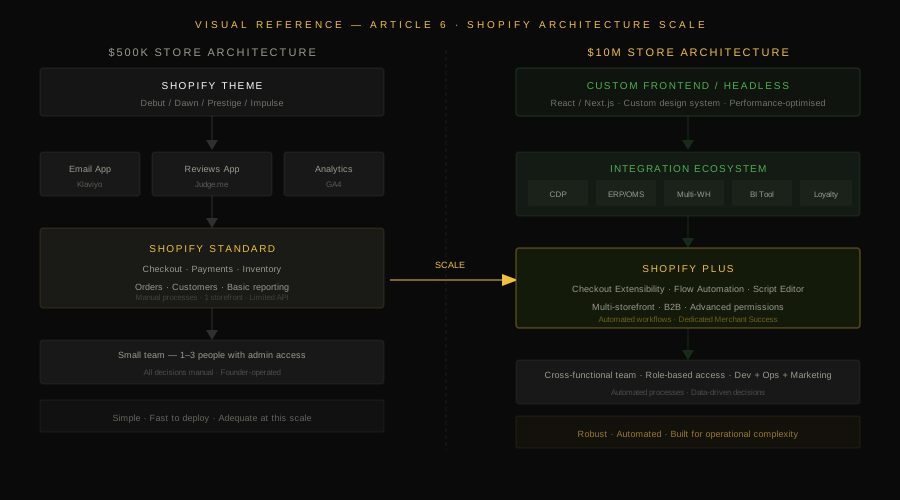
The transition from Shopify standard to Shopify Plus is not purely a feature upgrade. It is a platform philosophy shift. Shopify Plus gives scaling brands access to the Shopify infrastructure at a deeper level: custom checkout experiences, Script Editor and Checkout Extensibility for complex discounting and logic, Flow for sophisticated automation, B2B functionality, multi-storefront management, and the API rate limits that high-volume operations require.
The specific capabilities that become essential at the $10M level include: checkout customisation for brands whose purchase flow has specific requirements that the standard checkout cannot accommodate; multi-location inventory for brands operating across multiple warehouses or fulfilment centres; automation workflows that handle the operational volume that manual processes cannot sustain; and advanced user permissions for the larger teams that require different levels of platform access.
The hidden cost of delayed migration: Many brands delay moving to Shopify Plus because the monthly cost increase is visible and the operational cost of staying on standard is invisible. By the time the operational cost becomes visible — in the form of manual work, error rates, and missed automation opportunities — it has already cost significantly more than the platform upgrade would have.
The Data and Personalisation Gap
At $500K, personalisation is largely aspirational for most brands — the customer data exists but the infrastructure to act on it systematically does not. At $10M, personalisation is not aspirational; it is a revenue imperative. The brands operating at this scale have enough customer data to drive meaningful personalisation, and the difference between personalised and non-personalised customer experiences at this stage represents a significant and measurable revenue gap.
Building genuine personalisation capability on Shopify at scale requires a customer data architecture that goes beyond what the native platform provides: a CRM or CDP (Customer Data Platform) that aggregates customer behaviour across channels, integration with email and SMS platforms that can act on segmentation logic in real-time, and product recommendation infrastructure that is based on actual behaviour data rather than algorithmic defaults.
International Complexity
Many brands reaching the $10M threshold have begun meaningful international revenue, typically in 2-4 markets alongside their primary market. This introduces a category of complexity that does not exist at $500K: multi-currency pricing that reflects actual market pricing strategy rather than converted home-currency prices, localised checkout experiences for markets with specific payment method requirements, and the logistics architecture to support different fulfilment models across geographies.
For brands serving both US and UAE markets — a common configuration for premium DTC brands with international ambitions — the specific requirements are significant. UAE customers expect AED pricing, local payment methods including Tabby and Tamara for BNPL, and fulfilment speeds that reflect regional logistics rather than international shipping. Building this correctly into a Shopify architecture requires specific expertise that goes well beyond a basic international setup.
Technical Debt and the Migration Decision
One of the most consequential decisions a $10M brand faces is whether its current Shopify architecture can scale further or whether it has accumulated enough technical debt to require a rebuild. Theme customisations layered over years of growth, app dependencies that conflict with each other, custom code that interacts poorly with platform updates — these are the invisible liabilities that slow down every subsequent change and create a growing maintenance burden.
The correct answer is rarely a full rebuild from scratch. It is almost always a structured migration: identifying the specific constraints in the current architecture, designing a path that preserves what works while replacing what doesn’t, and executing the migration in a way that does not create business disruption. Getting this analysis right requires deep Shopify expertise — the ability to distinguish between technical debt that is worth carrying and debt that is genuinely constraining future growth.
Approaching or past the $5M mark?
We work with scaling Shopify brands on platform strategy, architecture assessment, and migrations that address the constraints before they become crises.