High average order value ecommerce has a peculiar conversion problem. The analytics look reasonable. Bounce rates are acceptable. Time-on-site is long. Product page views are healthy. But conversion rates are persistently disappointing — and the standard conversion optimisation playbook doesn’t move the needle. More urgency. Faster checkout. Sticky add-to-cart. None of it works.
The reason is straightforward: the CRO playbook was written for transactional retail with low-consideration purchase decisions. For products priced at $500, $1,500, or $5,000+, the conversion mechanism is fundamentally different. The friction that prevents conversion is not operational — it is psychological. And the specific psychological friction points that kill high-AOV conversion are almost entirely invisible in standard analytics.
The Trust Gap Before the Cart
The most consequential conversion failure in high-AOV ecommerce happens long before a customer reaches the add-to-cart button. It happens in the first 90 seconds of the experience, when the customer is unconsciously asking a series of questions that have nothing to do with the product: Do I believe this brand is real? Do I believe it is at the level it claims to be? Do I trust this site with a significant amount of my money?
Standard analytics cannot see this process. Session recordings and heatmaps can gesture at it. But the conversion decision for a high-ticket item is largely made during this early trust assessment — and the UX signals that fail this assessment are often the most invisible ones.
The trust signals that matter for high-AOV purchases are different from the trust signals that matter for low-ticket ones. A low-ticket purchase is reassured by reviews, badges, and security icons. A high-ticket purchase is reassured by design quality, brand coherence, and the sense that the digital experience matches the quality of the product it represents. A store that looks like it was built quickly on a template communicates, implicitly, that the brand is not at the level it claims to be — and that communication happens within seconds of arrival.
Information Pacing Errors
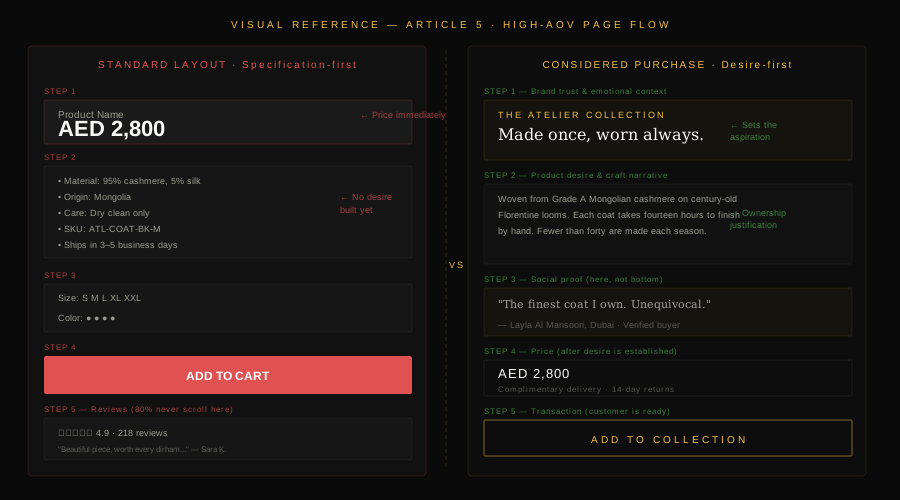
High-AOV products require a considered purchase journey. The customer needs to move through a specific psychological sequence: brand trust, product desire, ownership justification, purchase readiness. Most Shopify product pages attempt to address all of these simultaneously by placing all information in a single block alongside the product images — and the result is that none of them are addressed effectively.
The specific pacing errors that kill high-AOV conversion include: leading with price before establishing desire (a $2,000 price point shown before the customer has been given a reason to want the product is a conversion killer), compressing the ownership justification narrative into bullet points (the considerations that justify a high-ticket purchase require paragraph-level depth, not list format), and placing social proof at the bottom of the page where it is seen only by customers already committed to purchasing.
Mobile UX for Considered Purchases
One of the most significant structural problems for high-AOV ecommerce on mobile is that mobile UX design principles were largely developed for low-consideration, transactional purchases. The mobile checkout optimisation literature is dominated by fast-fashion and consumer electronics case studies — purchase decisions where speed of execution is the primary variable.
High-AOV mobile purchase decisions require a fundamentally different approach. Customers making considered purchases on mobile are spending significantly more time in research mode and significantly less time in transaction mode than their low-AOV counterparts. The UX implications include: mobile product pages that support reading behaviour rather than rushing toward the CTA; product imagery optimised for the zoomed, examined, inspected mode of high-consideration mobile browsing; and trust signal placement that addresses the specific anxiety of making a large financial commitment from a small screen.
Observed pattern: Brands that optimise their mobile experience for the “commute browser” who is in early consideration often see higher conversion from desktop for the same products — not because mobile can’t convert high-AOV, but because the mobile experience was optimised for transaction rather than considered purchase research.
The Return Policy as Conversion Signal
In high-AOV ecommerce, the return policy is not primarily an operational policy. It is a brand statement about how confident the brand is in its products and how it views its relationship with its customers. A restrictive or hard-to-find return policy on a high-ticket item communicates that the brand expects customers to be dissatisfied. A generous, clearly stated return policy communicates that the brand is confident in the quality of what it sells.
The placement and language of return policies on product pages is a surprisingly high-impact variable for high-AOV conversion. Brands that surface return information naturally within the product page context — not buried in a footer or hidden behind a small text link — consistently demonstrate better conversion rates on high-ticket items. The psychologically effective placement is within the “risk reduction” section of the product page, alongside other commitment-reducing information rather than in a utility context.
Why Checkout Abandonment Differs in High-AOV
High-AOV checkout abandonment is primarily caused by last-minute doubt, not checkout friction. The customer has made the purchase decision by the time they enter checkout — what prevents completion is a doubt that arises at the moment of financial commitment. This doubt is rarely addressed by faster checkout experiences. It is addressed by checkout experiences that reassure commitment rather than simply facilitating transaction.
The specific elements that reduce commitment doubt at checkout for high-AOV purchases include: order summary designs that reaffirm the quality of what is being purchased (not just the specifications), visible and reassuring communication about the post-purchase experience (delivery timeline, packaging quality, returns process), and payment option flexibility that allows the customer to choose the commitment structure that feels most comfortable for the amount involved.
Is your high-AOV store converting at its potential?
We audit Shopify stores specifically for high-ticket conversion friction — the problems that standard analytics can’t see but customers are consistently responding to.