There is a counterintuitive relationship between how much a premium ecommerce experience shows and how much it converts. The conventional CRO wisdom — show more, provide more information, reduce information-seeking friction — is correct for transactional retail. For high-consideration, premium purchases, the relationship is often reversed. The restraint itself is the conversion mechanism.
Understanding why requires stepping back from tactical conversion optimisation and into the psychology of how high-ticket purchase decisions are actually made.
The Psychology of Restraint in Premium Purchasing
When a customer encounters a dense, information-rich product page for a $2,000 item, their cognitive system is placed in evaluation mode. They begin comparing, weighing specifications, looking for reasons not to purchase. The information architecture has invited rational scrutiny — and rational scrutiny is not the psychological state in which high-ticket purchases are most readily made.
When the same customer encounters a sparse, restrained product page that surfaces the essential information with confidence and surrounds it with meaningful negative space, something different happens. The edit itself communicates authority. The brand has made choices about what matters. The customer is being guided rather than being left to evaluate. The psychological state this creates is closer to aspiration than evaluation — and aspiration converts high-ticket items significantly more reliably than evaluation does.
This is not a manipulation. It is an accurate reflection of how premium products are actually sold in their best physical retail environments. The finest jewellery is not presented in glass cases crowded with every piece in the collection. It is presented selectively, in a context that amplifies each individual item’s presence. Digital restraint achieves the same psychological outcome through the same mechanism.
What Restraint Means Specifically
Visual restraint in ecommerce has several specific operational expressions that go beyond “use less content”:
Selective product presentation. Collections pages that present a curated selection with adequate space for each item rather than a dense grid optimised for maximum product visibility. The curated approach reduces individual product visibility while increasing the perceived quality and desirability of each presented item.
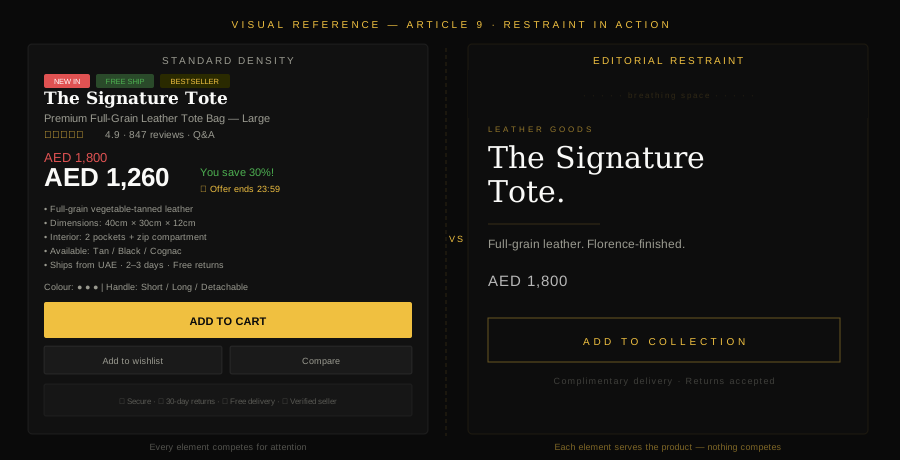
Restrained promotional communication. Premium brands that use restraint effectively communicate their value propositions — free shipping, returns, sustainability, craftsmanship — without the visual noise of badges, icons, and promotional callout boxes. The information is present; the visual weight of how it is presented does not compete with the product.
Typographic economy. Every text element on a premium product page should be earning its presence. Subheadings that are not necessary for navigation do not exist. Descriptive body copy uses enough words to communicate and stops. The typography communicates that the brand values precision over comprehensiveness.
Restraint and Information Hierarchy
One of the most powerful applications of visual restraint is in managing information hierarchy — the implicit prioritisation of information that tells a customer what matters. When everything on a page has similar visual weight, nothing has priority. The customer must decide for themselves what to pay attention to first, and that decision is both cognitively taxing and often wrong from the brand’s perspective.
Restrained design creates clear hierarchy through difference: the product name at a scale that establishes primacy, a single key descriptive statement at a weight that signals importance without competing with the name, supporting detail at a clearly subordinate scale. This hierarchy guides the customer through an information sequence that the brand has designed — from the product’s emotional character to its practical details to its transaction elements.
Hierarchy insight: In premium ecommerce, the most effective product pages are typically the ones where a customer could identify what product they are looking at, what it costs, and why it costs that amount from the first third of the page — with all remaining information serving to deepen rather than establish the purchase case.
Where Restraint Specifically Converts
The conversion impact of visual restraint is most pronounced at specific points in the customer journey. On collection pages, restrained presentation increases the rate at which customers click through to individual products — the editorial quality of the presentation creates curiosity and desire that dense grids suppress. On product pages, restrained information architecture increases the time customers spend in the upper consideration sections before reaching the transaction section — which correlates with higher conversion at the transaction step. At checkout, visual restraint that preserves the premium experience through the transaction flow reduces late-stage drop-off from the doubt that incoherent checkout experiences create.
The Discipline Required
Executing restraint consistently requires discipline that is both design-side and client-side. Design discipline means resisting every instinct to explain, clarify, and supplement — trusting that the product and the curation speak clearly enough. Client-side discipline means accepting that a restrained experience may feel incomplete or sparse during review, and understanding that this feeling is exactly the discomfort of doing something genuinely different from what everyone else is doing.
The brands that execute restraint most effectively — whether a contemporary jewellery brand in London, a premium skincare company based in Sydney, or a luxury accessories brand targeting the UAE market — share a common characteristic: they trust their product enough to let it be the centre of attention, without surrounding it with everything else they feel the need to say.
Ready to let your product speak through restraint?
We build visually restrained Shopify experiences for premium brands that understand the conversion power of deliberate editing.