Every year, a new cohort of ecommerce brands decide they want a minimal store. They show reference images — a beautifully spare fashion brand, a pristine skincare homepage, a high-end watch retailer with nothing but product and negative space. “We want something like this,” they say. “Clean. Simple. Minimal.”
The misunderstanding embedded in this request is almost universal: minimalism is being described as if it were an aesthetic choice, when it is actually a structural discipline. The stores those reference images represent are not minimal because someone removed things. They are minimal because someone made extraordinarily precise decisions about what to keep — and those decisions were made with a depth of strategic clarity and craft skill that complex design rarely requires.
The Cost of Removal
Complexity in ecommerce design hides problems. A dense layout with many visual elements, rich colour, multiple competing calls-to-action, and layered information creates a kind of visual noise that obscures the quality of individual decisions. When everything is busy, nothing needs to be perfect. The eye is distributed across many elements and its judgment is softened by visual chaos.
Minimalism removes this protection. In a spare, restrained layout, every remaining element carries enormous weight. The quality of a single typographic decision — the weight, the size, the spacing — becomes plainly visible. The relationship between two elements on a page that would disappear into complexity becomes the visual subject of the entire layout. Every margin, every piece of white space, every colour choice is legible in isolation.
This is why minimal ecommerce fails so frequently. Brands attempt minimal execution without the strategic clarity to know what is worth keeping, without the craft skill to execute the remaining elements at the quality level that exposure requires, or without the discipline to resist adding things back when the space feels uncomfortable.
“Complexity is cheap. You can add elements indefinitely and the additional decisions become progressively smaller. Minimalism is expensive. Each element you keep must be worth the scrutiny it receives by existing in a spare environment.”
What Minimal Actually Requires
Genuinely minimal ecommerce experiences are built on three foundations that complex designs rarely need to develop in the same depth: extreme clarity of brand communication, craft-level execution of retained elements, and structural confidence in white space.
Brand communication clarity means knowing, with precision, what you need every customer to understand about the brand within the first five seconds of arriving on the homepage. Complex designs can suggest this understanding without actually delivering it — there are enough visual elements to create an impression even without clarity. Minimal designs cannot. If the brand communication is not crystalline, the minimal execution will feel empty rather than restrained.
Craft-level execution means that the typography is not just technically correct but genuinely beautiful. The product photography is not just well-shot but art-directed for the specific purpose of existing in the context of significant negative space. The colour palette is not just harmonious but psychologically calibrated to the emotional experience the brand is trying to create. None of these requirements are optional in a minimal design — they are the load-bearing elements that the entire experience rests on.
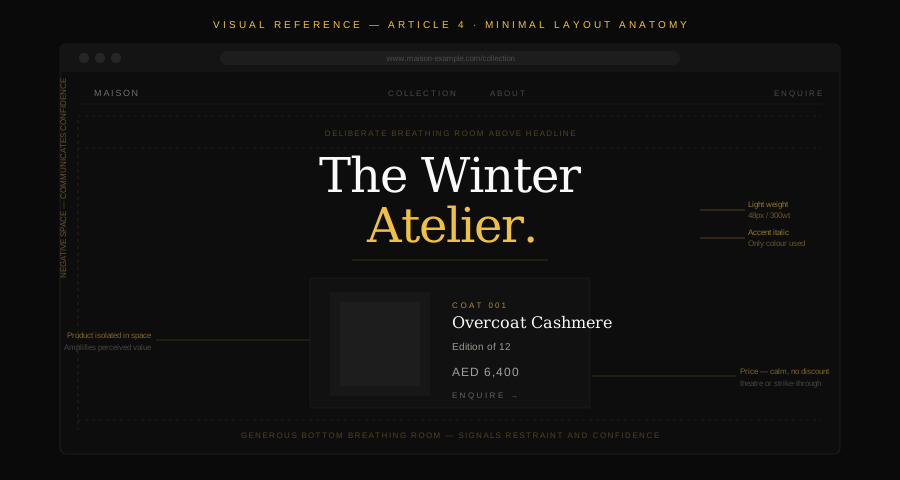
The Negative Space Discipline
Negative space is not the absence of content. It is an active design element with specific communicative functions. In the context of premium ecommerce, generous negative space communicates: confidence (the brand does not need to fill every pixel to hold the customer’s attention), selectivity (the products shown have been chosen with intention, not simply listed), and value (products that exist in space appear more valuable than products that are compressed into density).
The psychological mechanism here is well-documented in retail contexts: the physical retail equivalent is the high-end department store vs. the discount retailer. Premium retail uses space to amplify the perceived value of individual items. Digital retail that does the same produces measurable increases in perceived product value and willingness to pay — but only when the execution is genuinely confident. Negative space that looks like a layout that hasn’t been finished produces the opposite effect.
This is the discipline that most minimal ecommerce attempts collapse at. The space feels uncomfortable to clients who are not used to seeing it. Stakeholders feel that the store is “not saying enough” or “looks empty.” The pressure to fill the space accumulates until the minimal design has been diluted to the point where it retains the aesthetic aspiration without the psychological impact.
Practical insight: The client review process is one of the most dangerous phases of a minimal ecommerce project. Every stakeholder instinct about “adding more content” or “making it feel more complete” is, in most cases, a direct instruction to destroy the design’s premium perception. Protecting minimal execution requires as much strategic skill as producing it.
Mobile and the Minimal Challenge
Minimal design faces a particular challenge on mobile: the constraints of small screens create a natural pressure toward density, since the information that must be communicated does not change while the available space shrinks dramatically. Most minimal desktop designs do not survive translation to mobile intact.
Premium brands operating in Singapore, UAE, and other mobile-first markets where high-end digital retail is primarily experienced on smartphone screens must resolve this tension explicitly. The solution is not simply responsive scaling — it is rethinking the information architecture for mobile as a distinct experience, preserving the psychological principles of the desktop design (restraint, selectivity, confident negative space) through different structural means rather than simply shrinking the desktop layout.
When Minimal Is Wrong
Minimal ecommerce is not appropriate for every brand, product category, or customer audience. It is a design discipline best suited to brands with strong visual assets (product photography and brand photography that can carry the weight of sparse layouts), a premium positioning that benefits from perceived exclusivity, and a customer base that is visually sophisticated enough to read restraint as quality rather than incompleteness.
For brands with highly technical products that require detailed specification comparison, for retailers with large catalogues where browsing efficiency is the primary UX goal, or for markets where visual richness is a positive signal of value rather than a signal of mass-market positioning — minimal is not the answer. Understanding when to use it is part of the strategic discipline it requires.
Is minimal the right direction for your brand?
We help premium Shopify brands understand whether their product, market, and positioning support minimal execution — and build it to the standard it requires.