There is a persistent assumption in luxury ecommerce that mobile is a research channel and desktop is a purchase channel. The assumption is based on historical data that no longer reflects current behaviour — particularly in the markets where luxury ecommerce is growing fastest.
In the UAE, where smartphone penetration is among the highest globally and mobile commerce infrastructure is mature, high-ticket purchases on mobile have become normative rather than exceptional. In Singapore and Hong Kong, markets with sophisticated mobile payment ecosystems and consumer bases accustomed to premium mobile experiences across every sector, the idea that luxury purchases happen primarily on desktop is factually incorrect. The brands that still build for this assumption are building for an audience that increasingly does not exist.
Where Luxury Mobile Currently Fails
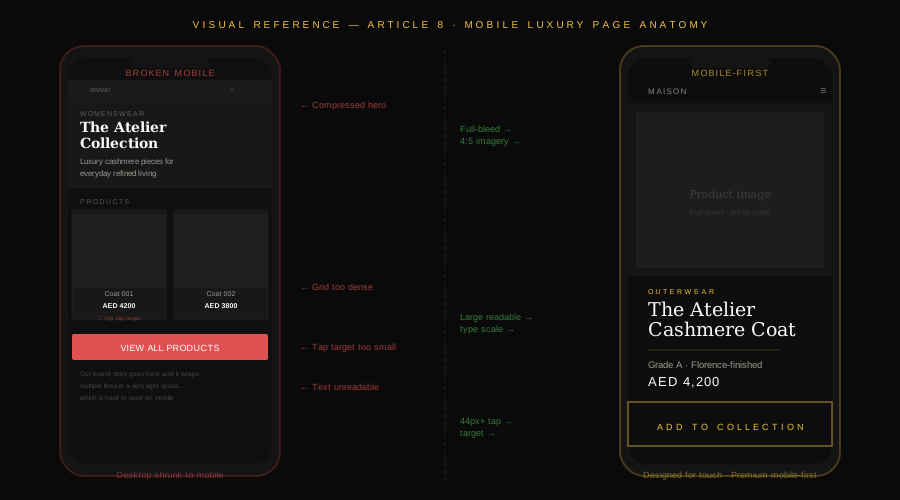
The most common failure mode in luxury mobile ecommerce is what might be called compressed luxury — a desktop design that has been responsively scaled to mobile without rethinking the experience for the different context, interaction model, and psychological state of a mobile user. The result is a store that has the visual language of luxury at a size and interaction model that creates friction and breaks the premium perception.
Navigation is a primary failure point. Desktop luxury navigation systems often rely on hover states, mega-menus, and precise cursor positioning that translate poorly or not at all to touch interaction. The mobile version that results from responsive scaling is typically either overly simplified (losing the sense of editorial depth the desktop navigation conveyed) or overly complex (requiring multiple taps to reach product areas that the desktop version reached in a single hover).
Product photography is a second critical failure point. Luxury product pages on desktop frequently use large, full-bleed imagery that communicates product quality through scale and visual impact. On mobile, the same images at scaled dimensions often fail to communicate the quality they were shot to convey — particularly for products where the detail of the photography (material texture, finish, craftsmanship) is central to the purchase consideration.
Touch as a Luxury Medium
The fundamental insight that most luxury mobile experiences miss is that touch interaction, when treated as a premium medium rather than a desktop compromise, offers unique opportunities that do not exist in cursor-based interfaces. Luxury physical retail is inherently tactile — the quality of a fabric, the weight of a pen, the feel of hardware fittings. Digital luxury cannot replicate this, but it can honour the principle through interaction design that feels deliberate, responsive, and of high quality.
The specific interaction qualities that create premium perception on mobile include: gesture responses that feel precise and intentional rather than mechanical, animation timing calibrated to feel like the interaction has physical weight, image viewers that reward detailed examination with smooth zoom behaviour, and form interactions (selecting variants, entering details) that feel as considered as the product presentation itself.
“Mobile luxury is not about adapting a desktop luxury experience to a smaller screen. It is about building a luxury experience in a medium where touch is the primary sensory input — and treating that touch interaction with the same craft attention that luxury brands give to physical product experiences.”
Performance as a Luxury Signal on Mobile
Mobile performance is not just a technical metric for luxury ecommerce — it is a brand signal. A luxury mobile experience that loads slowly, jumps during scroll, or displays images progressively from blurred to sharp communicates, through these failures, that the brand does not extend its attention to quality into its digital infrastructure. For customers accustomed to premium experiences across every aspect of their lives, this is a disqualifying signal.
The performance standard for luxury mobile in 2026 requires not just acceptable Core Web Vitals scores but a perceived performance that is instantaneous — images that appear at full quality immediately, interactions that respond without detectable latency, and scroll behaviour that is perfectly fluid. These are achievable on Shopify with deliberate performance architecture. They are not achievable without it.
Observed market difference: UAE premium customers, who regularly use high-end apps across banking, retail, and hospitality sectors, have a performance reference point calibrated to the best mobile experiences available. A Shopify luxury store that loads in three seconds is not competing against other Shopify stores in their perception — it is competing against the Emirates app, the Chalhoub Group’s digital experiences, and other premium mobile products they use daily.
Mobile Checkout for High-Ticket Purchases
The mobile checkout experience for high-ticket purchases requires specific attention that generic checkout optimisation does not provide. The psychological dynamics of completing a significant financial commitment on a mobile device are different from doing so on a desktop: there is greater ambient anxiety (the purchase feels less deliberate on a device associated with casual consumption), less sense of formality and consideration, and higher drop-off risk at the moment of entering payment details.
Premium mobile checkout design addresses these dynamics through specific mechanisms: reducing the number of mandatory steps to the absolute minimum, making the order summary easily accessible and visually reassuring throughout the checkout, prioritising Apple Pay and other one-step payment methods that reduce the friction of the payment commitment, and ensuring that every interaction in the checkout flow feels as considered and high-quality as the product pages that preceded it.
Building Mobile-First Luxury Architecture
The correct approach for new luxury Shopify builds in 2026 is mobile-first design architecture: designing the mobile experience as the primary experience and deriving the desktop experience from it, rather than the reverse. This approach produces fundamentally different structural decisions that result in mobile experiences that are genuinely premium rather than compromised adaptations of desktop designs.
For existing luxury Shopify stores with desktop-first architectures, the path is usually not a complete rebuild but a structured mobile audit and enhancement programme: identifying the specific points where the current mobile experience breaks or weakens the premium positioning, and addressing those points through targeted improvements to both the design layer and the performance layer.
Does your mobile experience match your brand’s premium positioning?
We audit and rebuild mobile luxury experiences for premium Shopify brands across the UAE, UK, USA, and Singapore.